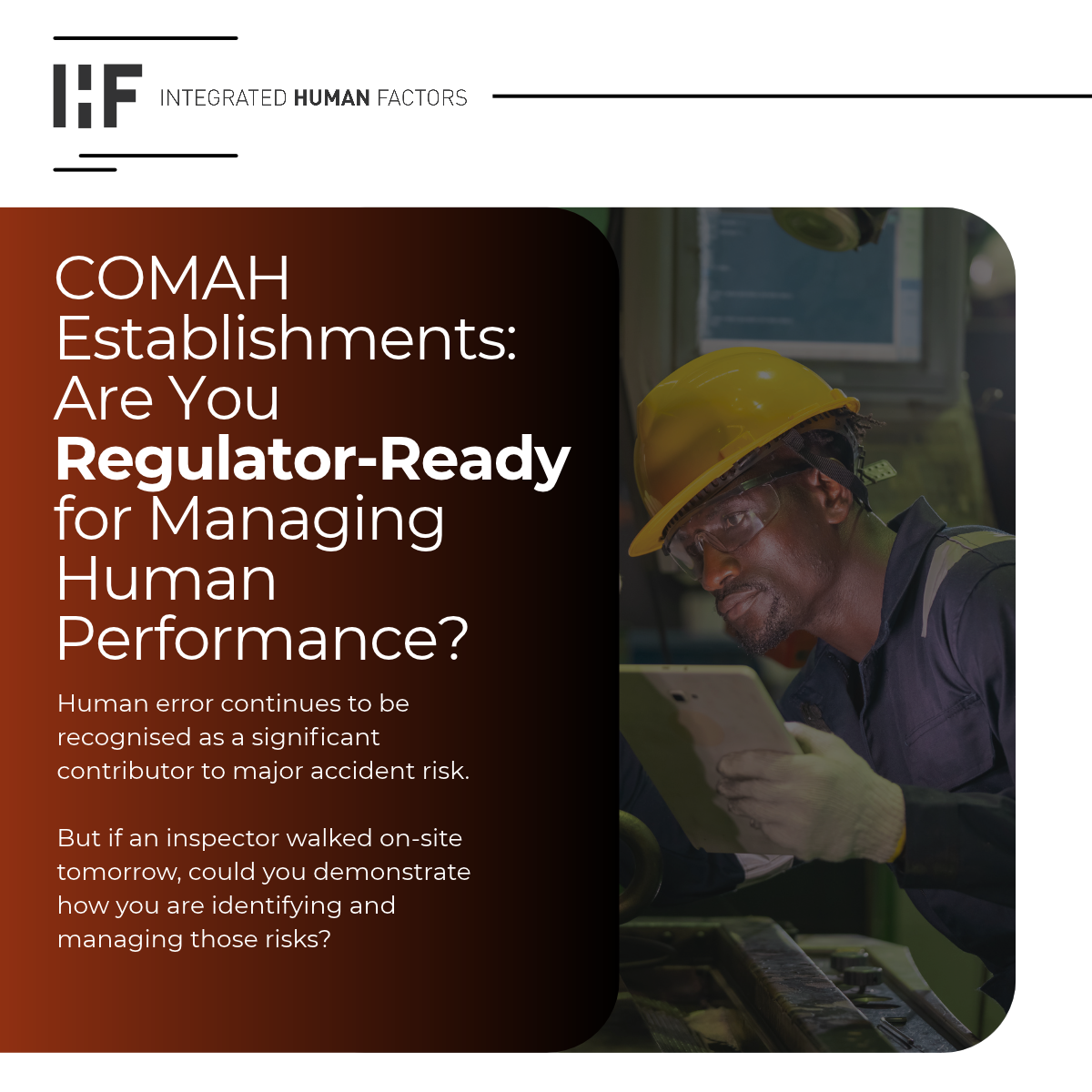
Topic 1 of the COMAH Competent Authority: Inspecting Human Factors at COMAH Establishments Delivery Guide relates to “Managing Human Performance” and Human Factors Specialist Inspectors are likely to inspect and rate this topic first, making this an integral part of the general duty under COMAH and Regulation 5 of The Control of Major Accident Hazards Regulations 2015. Paragraph 82 of the L111 Guidance on Regulations states:
“Where reliance is placed on people as part of the necessary measures, human factor issues should be addressed with the same rigour as technical and engineering measures.”
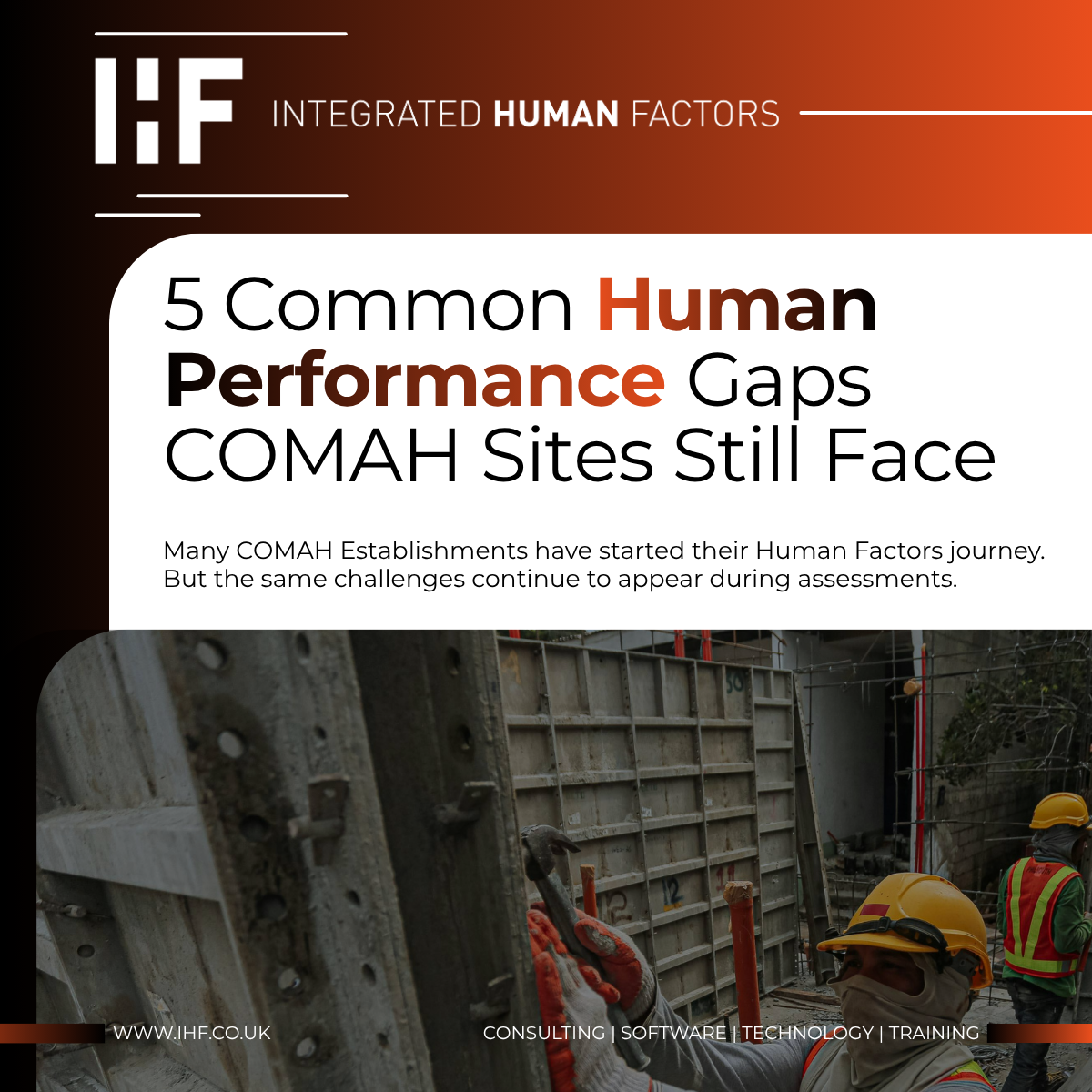
Many COMAH Establishments have started their Human Factors journey. But the same challenges continue to appear during assessments.
Gap 1: Treating SCTA as a Compliance Exercise
Often, organisations focus on completing assessments because they are required to. However, IHF see that the most successful organisations are those that use Safety Critical Task Analysis (SCTA) as a tool to genuinely understand and reduce human error risks that could potentially occur within their business.
Gap 2: Treating SCTA as a One-Off Exercise
A common misconception is that once an assessment has been completed, the job is done. When, in reality, sites can change, plans can change, procedures can change and people can change. Organisations need to realise that Human Performance programmes need to evolve alongside them and take into account different change factors they are likely to encounter.
Gap 3: The Right People Are Not Involved
An assessment’s quality depends heavily on the people contributing to it. When workshops exclude people with practical experience carrying out the task, they can miss important insights. The people closest to the work are often the ones who understand where things can actually go wrong.
Gap 4: Recommendations Do Not Immediately Become Improvements
Many organisations are good at identifying improvement actions. However, far fewer consistently see them through to completion. Without clear ownership, realistic timescales and ongoing review, even the best recommendations can lose momentum.
Gap 5: Automation is Changing Where Human Performance Risks Exist
As sites become increasingly automated, risks do not disappear, they just move elsewhere. Today, many of the most safety-critical opportunities for human error exist during calibration, testing, fault-finding and maintenance activities. Therefore, it is important that these tasks receive the same level of attention as routine operations.
Five Questions To Ask Yourself
- Have all COMAH-critical tasks been assessed?
- Have maintenance activities been considered?
- Have abnormal and emergency response tasks been included?
- Could you explain the actions arising from the assessments?
- Could more be done to reduce the likelihood of human error?
Further Reading
- 5 Common Human Performance Gaps COMAH Sites Still Face
- COMAH Establishments: Are You Regulator-Ready for Managing Human Performance?
- Dr. Chizaram Nwankwo: Performance Influencing Factors (PIFs) in Safety Critical Task Analysis (SCTA)
- How to Conduct a Safety Critical Task Analysis (SCTA)
- IHF Webinar: An Introduction to Safety Critical Task Analysis (SCTA)
- Safety Critical Task Analysis (SCTA) Software (TASC™)
- What Good Human Performance Management Actually Looks Like Under COMAH Regulations
- Work-as-Imagined (WAI) vs Work-as-Done (WAD)