In safety-critical industrial operations, dangerous tasks that rely on people to undertake them have been a contributory factor in many accidents, incidents and near misses. According to the COMAH Competent Authority, operators should use risk assessment and findings from accident and incident investigations to gain a clear understanding of where and when they are vulnerable to human failure (COMAH-critical tasks), how those failures are likely to occur — accounting for the different types of human error — and the Performance Influencing Factors (PIFs) that make those human errors more likely.
The fundamental purpose of SCTA is to identify areas in a task that are susceptible to human failure and could result in a major accident, as well as strengthening the controls in place to mitigate the risks.
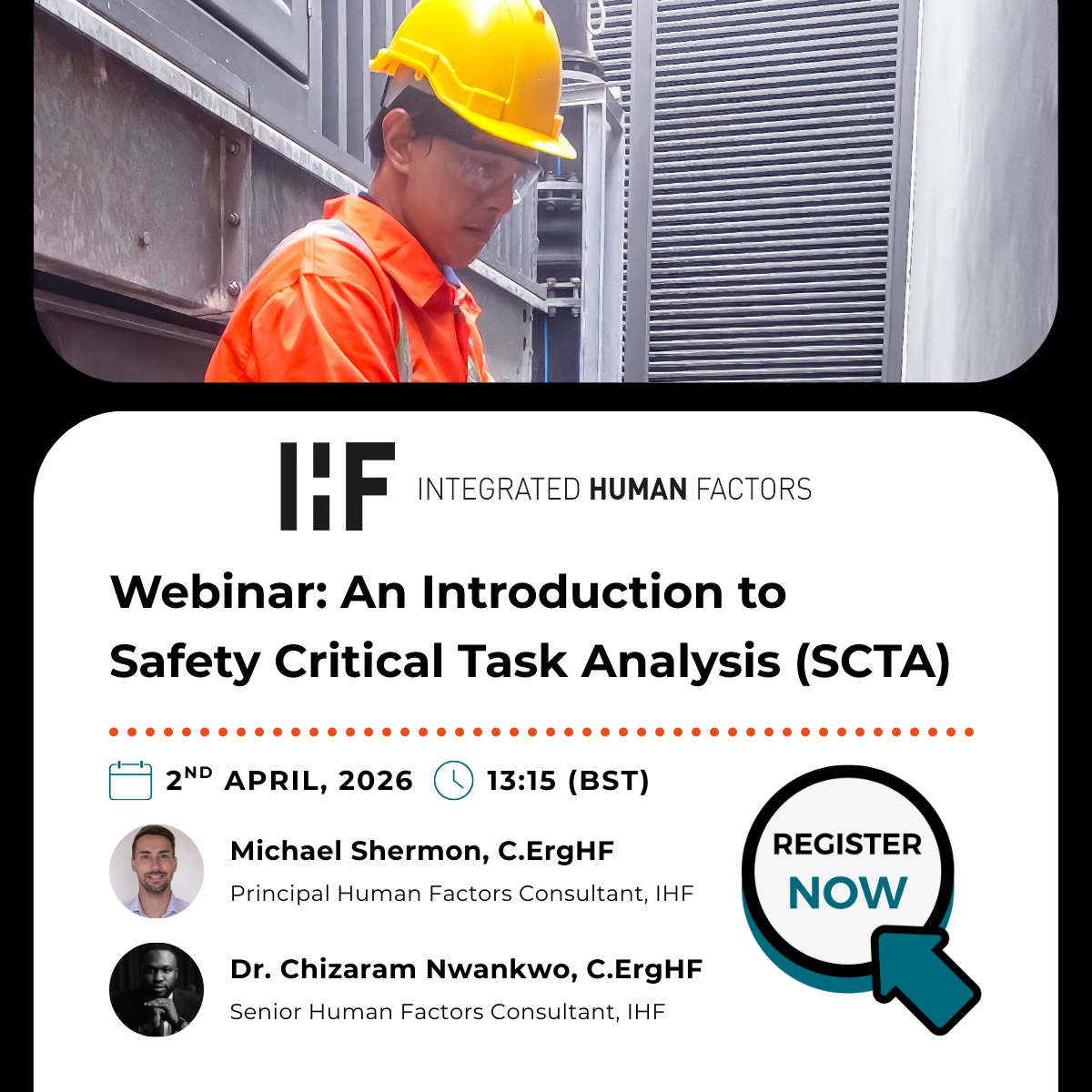
In this webinar — that was broadcast on the 2nd of April, 2026 — Michael Shermon, C.ErgHF and Dr. Chizaram Nwankwo, C.ErgHF — human factors consultants at IHF — provide an overview of SCTA and how IHF — a registered consultancy with the Chartered Institute of Ergonomics and Human Factors (CIEHF) — can help an organisation implement and continuously develop an SCTA program.
This includes CIEHF accredited training, human factors consultancy services and IHF SaaS TASC™ software. Providing integrated SCTA solutions, designed to mitigate accidents and incidents whilst meeting COMAH-critical tasks compliance — by human factors experts — in line with CIEHF, Energy Institute (EI), Health and Safety Executive (HSE), Human Performance Oil & Gas (HPOG) and International Association of Oil & Gas Producers (IOGP) guidelines.
Watch: A recording of this webinar can be found at the IHF YouTube channel.
Connect with Michael Shermon, C.ErgHF and Dr. Chizaram Nwankwo, C.ErgHF on LinkedIn.
An Introduction to Safety Critical Task Analysis (SCTA) Webinar Chapters
This webinar provides an introduction to SCTA, a human factors methodology used to identify, assess and manage tasks that could contribute to major accident hazards. Topics include human error, Performance Influencing Factors (PIFs), regulatory requirements, IHF SCTA solutions including consultancy, training and software, and practical applications across high-hazard industries.
Introduction and Webinar Overview
Watch Chapter: An introduction to the webinar and the objectives of the session. This chapter outlines what SCTA is and how it supports the management of major accident hazards (MAH).
Defining Safety Critical Task Analysis (SCTA)
Watch Chapter: Learn what SCTA is, how it fits within the discipline of human factors and why organisations use SCTA to identify tasks that could contribute to major accidents, safety incidents and operational failures.
Human Error and Why Accidents Happen
Watch Chapter: Explore the role of human error in accidents and incidents, including slips, lapses, mistakes and violations. This section explains how PIFs can increase the likelihood of human failure and contribute to unsafe conditions.
Improving Safety, Quality and Performance With SCTA
Watch Chapter: Discover how SCTA can improve safety, quality and operational performance. Learn how organisations use task analysis to reduce errors, improve reliability and enhance process effectiveness.
Work as Imagined vs Work as Done
Watch Chapter: Understand the difference between documented procedures and actual work practices. This chapter explains why comparing work as imagined vs work as done is essential for identifying hidden operational risks.
The HSE Human Factors Roadmap
Watch Chapter: An overview of the HSE human factors roadmap that includes task identification, task analysis, human error analysis (HEA) and the implementation of effective controls.
IHF SCTA Process
Watch Chapter: A detailed walkthrough of the IHF SCTA process, including task screening, criticality assessment, hierarchical task analysis (HTA), site walkthroughs, HEA and action planning.
Real-World Example Highlighting the Importance of SCTA
Watch Chapter: A practical case study demonstrating how SCTA can identify a critical vulnerability in a safety-critical testing process and how targeted controls can help reduce the likelihood of human error.
SCTA Regulatory Requirements
Watch Chapter: Learn about the regulatory expectations surrounding SCTA, including requirements for COMAH sites, offshore facilities and other high-hazard industries.
IHF SCTA Solutions: Consultancy, Training and Software
Watch Chapter: Discover how IHF supports organisations through SCTA consultancy services, accredited SCTA training and SCTA software — IHF SaaS TASC — all designed to improve the management of safety critical tasks.
Human Factors Expertise is Essential in SCTA
Watch Chapter: Explore common SCTA challenges and pitfalls, including task identification, PIFs, evidence management and action implementation. Learn why human factors expertise is critical for successful outcomes.
SCTA Software: IHF SaaS TASC
Watch Chapter: Learn how the IHF SaaS TASC software platform supports task screening, task analysis, workshop management, evidence capture, action tracking and automated SCTA reporting.
IHF SCTA Solutions Benefits
Watch Chapter: Understand the benefits of implementing SCTA, including improved safety performance, regulatory compliance, operational efficiency, quality improvements and reduced organisational risk.
References and Further Reading
Watch Chapter: Review key guidance documents and industry references that support the implementation of SCTA.
Q&A: Identifying and Screening Safety Critical Tasks
Watch Chapter: Guidance on identifying safety critical tasks, screening methodologies and prioritising activities for detailed assessment based on risk and criticality.
Q&A: How Many SCTAs Should You Complete in a Year
Watch Chapter: Discussion of resource planning, prioritisation and practical considerations for implementing an effective annual SCTA programme.
Q&A: Can SCTA Be Used During Design Stages
Watch Chapter: Learn how SCTA can be applied during engineering and design phases to identify potential human error opportunities before equipment, facilities and processes become operational.
Q&A: Managing Similar Tasks Across Multiple Assets and Equipment
Watch Chapter: Explore approaches for grouping similar tasks across multiple assets and equipment types while maintaining effective risk assessment and human factors coverage.
Human Factors Maturity Assessment (Haitch-F™)
Watch Chapter: Learn about the Haitch-F Human Factors Maturity Assessment tool and how organisations can benchmark their human factors capability, identify strengths and develop improvement plans.
An Introduction to Safety Critical Task Analysis (SCTA) Webinar References
COMAH Competent Authority (2023) Inspecting Human Factors at COMAH Establishments: Delivery Guide. 1st edn (Version 1.1). COMAH Competent Authority.
Energy Institute (2020) Guidance on human factors safety critical task analysis. 2nd edn. Energy Institute.
Great Britain (2015) The Control of Major Accident Hazards Regulations 2015. SI 2015/483. London: HMSO.
Health and Safety Executive (2015) The Control of Major Accident Hazards Regulations 2015: Guidance on Regulations. 3rd edn (L111). Health and Safety Executive.
Health and Safety Executive (2021) Assessment Principles for Offshore Safety Cases (APOSC). 1st edn (APOSC: 2021/174769). Health and Safety Executive.