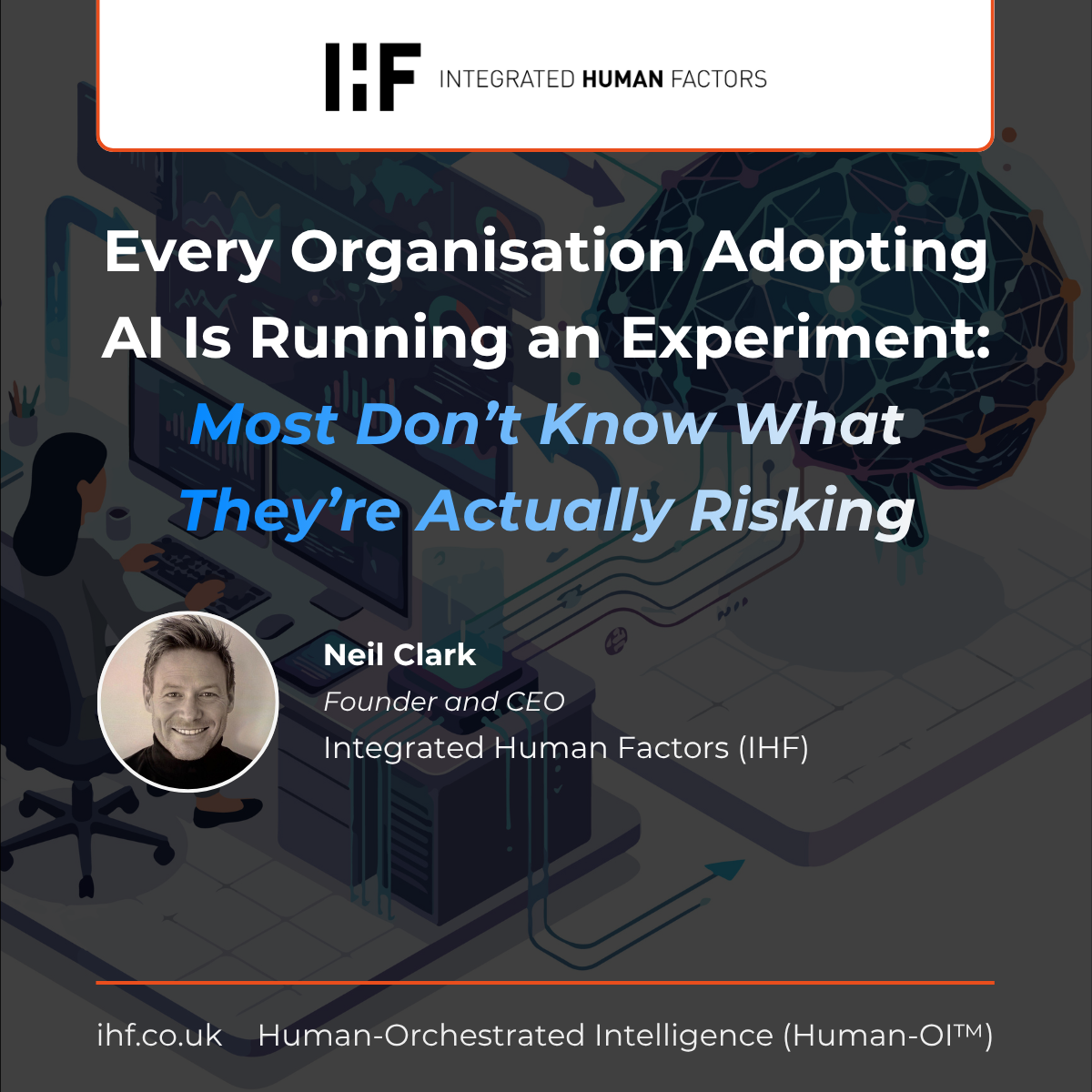
Human-in-the-Loop (HITL) is not, by itself, a control. The gap between having human oversight and having effective human oversight is a Human Factors problem, not an artificial intelligence (AI) problem.
Here is the harder question. What does it cost you when that gap fails?
A missed override. A confidently wrong output that nobody challenged. A decision made by someone without the training, time or authority to intervene in the system in front of them. These are not AI-related issues, they are the same failure modes Human Factors experts have studied for decades in aviation, defence, healthcare, maritime, nuclear, oil and gas, rail and other safety-critical industries, just with a new system doing the talking.
What is different now is speed and scale. An AI-enabled workflow can produce an error faster and propagate it wider than most manual processes ever could. When that error reaches a customer, a regulator or an incident investigation, the question will not be:
“Did you have a Human-in-the-Loop?”
It will be:
“Could that human have caught it, and can you prove it?”
That is the exposure most boards are not pricing in:
- Reputational Damage
- Regulatory Scrutiny
- Operational Disruption
Retrofitting human oversight after an incident always costs more than designing it in from the start. This is what Human-Orchestrated Intelligence (Human-OI™) is built to address.
IHF is not asking organisations to slow down AI adoption. Through Human-OI, we are giving them the evidence and structure to show their human oversight actually works, before someone else forces them to prove it.
The organisations moving fastest on AI right now are not the ones with the most tools. They are the ones who know exactly where their people sit in the loop, and what those people are actually capable of catching.
Connect with Neil on LinkedIn.
Further Reading
- Realising the Benefits of AI: By Designing the Human Role Effectively
- There’s Broad Agreement That AI Needs Human Oversight
- Why Responsible AI Adoption Is a Human Factors Problem