Building a proactive and data-driven fatigue detection system is not easy.
It requires a lot of investment, testing and trial and error.
Of course, one of the stumbling blocks of testing for fatigue in operational environments is the last thing you want to do is purposefully put fatigued individuals into an operational environment.
So, the vast majority of BaselineNC testing was done in synthetic or simulated environments.
One of the challenges of measuring fatigue with traditional means is the self-assessed and questionnaire-based nature of the subjective tools we currently use. It also takes quite a bit of courage from an individual — or an organisation — to put their hand up and say, “I am fatigued” and/or “you are fatigued” and there can be a stigma attached to self-reporting fatigue.
We ask potentially fatigued individuals to self-assess on their fatigued state. There are many ironies with this, as we know that one of the things that fatigue negatively impacts is our decision making, judgement and our ability to self-assess. So, there is a huge inherent flaw in the traditional ways of self-assessing fatigue.
The BaselineNC™ Workplace Fatigue Monitoring Wearable Assessment Reconstruction video also highlights this.
This video is a reconstruction — using actors — of a BaselineNC assessment that was held in a tram simulator. The driver who took part in the assessment was deliberately fatigued in order to test the wearable device. Therefore, this testing involved an operator simulating a safety-critical role.
The operator was asked in timed intervals to self-assess using the Karolinska Sleepiness Scale (KSS). Concurrently, the BaselineNC wearable device and algorithm was collecting and analysing biometric data.
Therefore, the KSS scores and biometric streams were monitored in parallel, and the results were quite astounding.
At the later stages of the tram driving simulation, two microsleeps were visually observed by the assessor and these correlated with the BaselineNC algorithm identifying red levels of fatigue.
Another visual observation made by the assessor was that a tram stop was missed.
The BaselineNC algorithm pre-emptively identified amber and red levels of fatigue hours before a level 8 KSS score was provided by the driver and two visually observed microsleeps.
The driver first self-identified as “unfit to drive” 5 minutes after the second visually observed microsleep.
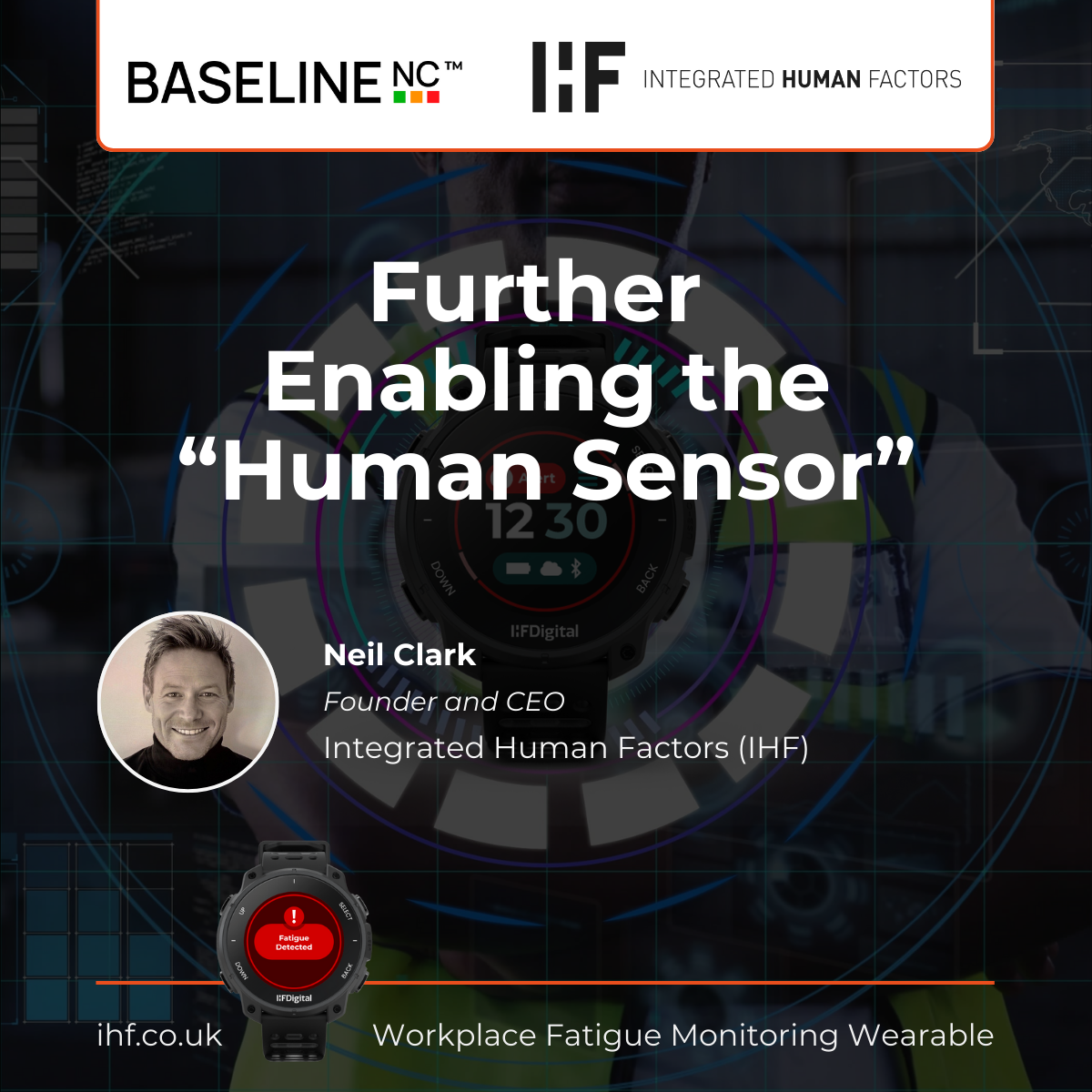
The assessment results showed the pre-emptive detection of the onset of worker fatigue by BaselineNC HOURS before two visually observed microsleeps and self-assessment by the driver. Ultimately, BaselineNC was able to highlight the driver’s steady decline to a state of dangerous fatigue.
Further emphasising that fatigue is a silent, ever-present risk across all sectors.
The BaselineNC Advanced Fatigue Monitoring System white paper provides operational evidence — from a combination of comprehensive IHF and independent assessment results — that BaselineNC delivers effective situational awareness monitoring of fatigue onset with 98% biometric data accuracy.
Connect with Neil on LinkedIn.
The BaselineNC workplace fatigue monitoring wearable project is also EIT Urban Mobility funded and was recently featured as part of the Impact Stories series: Wearable technology for human error prevention in transportation