In safety-critical industrial operations, dangerous tasks that rely on people to undertake them have been a contributory factor in many accidents, incidents and near misses. According to the COMAH Competent Authority, operators should use risk assessment and findings from accident and incident investigations to gain a clear understanding of where and when they are vulnerable to human failure (COMAH-critical tasks), how those failures are likely to occur — accounting for the different types of human error — and the Performance Influencing Factors (PIFs) that make those human errors more likely.
The fundamental purpose of SCTA is to identify areas in a task that are susceptible to human failure and could result in a major accident, as well as strengthening the controls in place to mitigate the risks.
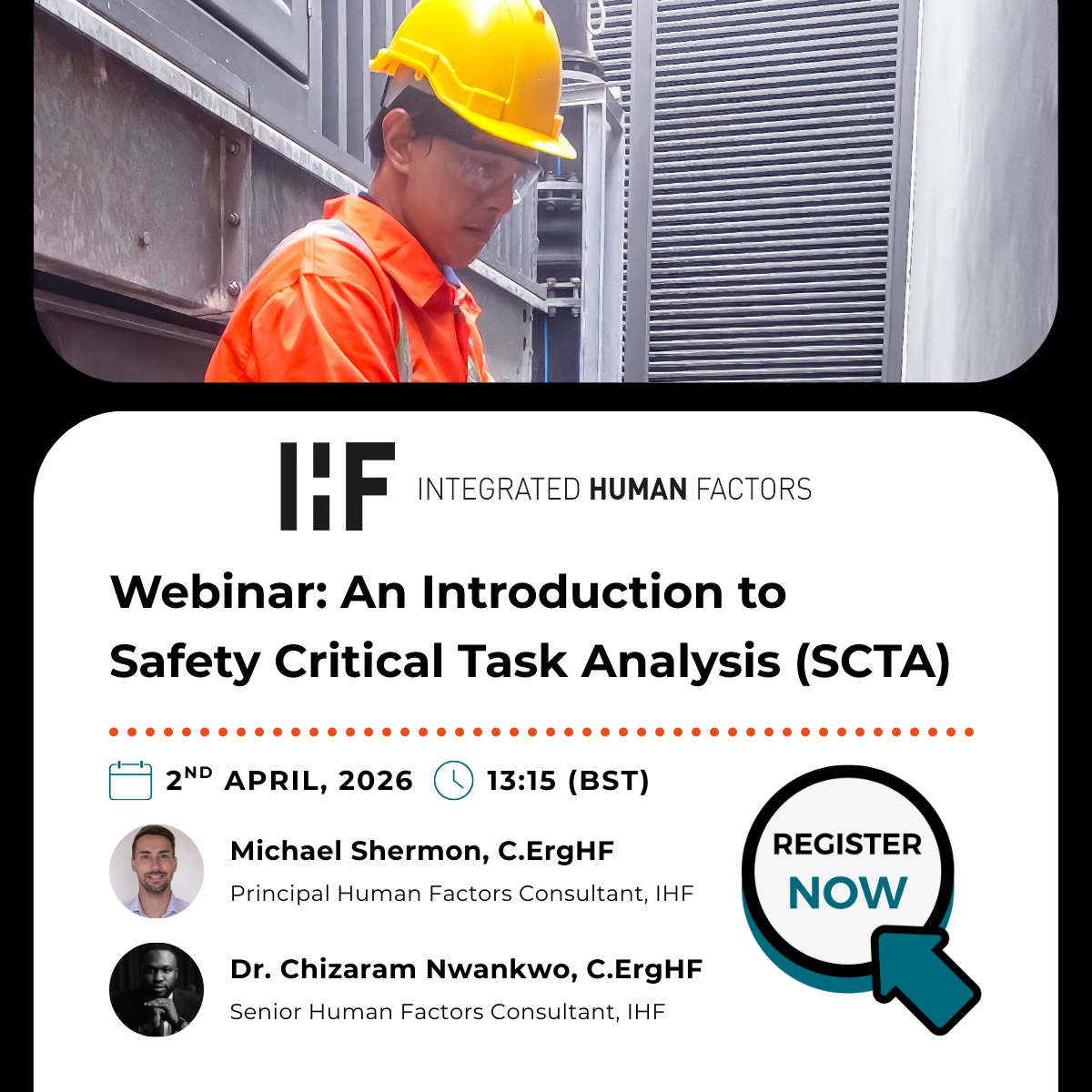
In this webinar — that was broadcast on the 2nd of April, 2026 — Michael Shermon, C.ErgHF and Dr. Chizaram Nwankwo, C.ErgHF — human factors consultants at IHF — provide an overview of SCTA and how IHF — a registered consultancy with the Chartered Institute of Ergonomics and Human Factors (CIEHF) — can help an organisation implement and continuously develop an SCTA program.
This includes CIEHF accredited training, human factors consultancy services and IHF SaaS TASC™ software. Providing integrated SCTA solutions, designed to mitigate accidents and incidents whilst meeting COMAH-critical tasks compliance — by human factors experts — in line with CIEHF, Energy Institute (EI), Health and Safety Executive (HSE), Human Performance Oil & Gas (HPOG) and International Association of Oil & Gas Producers (IOGP) guidelines.
Watch: A recording of this webinar can be found at the IHF YouTube channel.
Connect with Michael Shermon, C.ErgHF and Dr. Chizaram Nwankwo, C.ErgHF on LinkedIn.