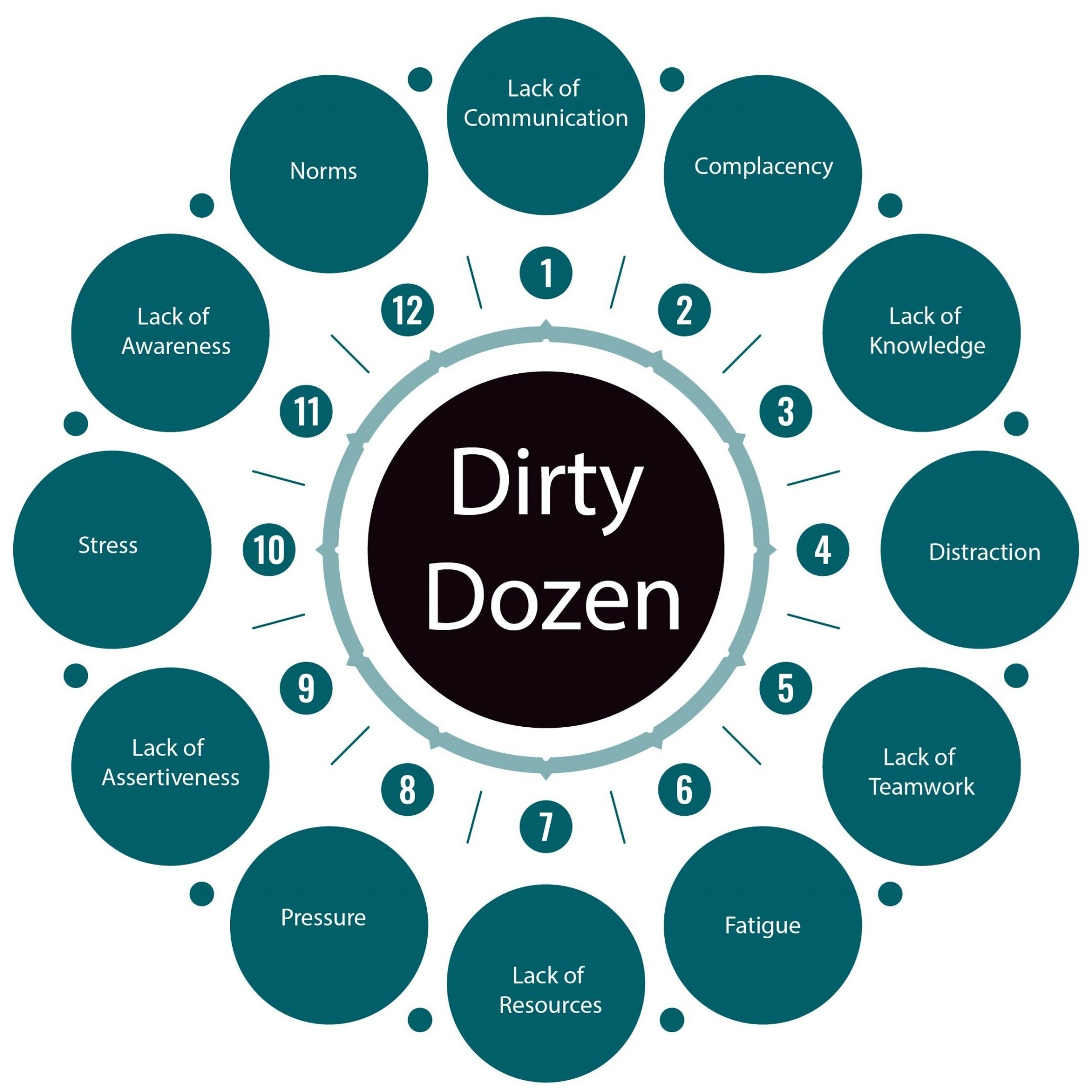
The “Dirty Dozen” refers to a list of 12 causes that influence human error. The phrase originated from Gordon Dupont who worked as an accident investigator with Transport Canada and noticed that many of the accident reports he submitted had the same human errors in common.
Integrated Human Factors (IHF) often recognise these factors as issues observed on a day-to-day basis in many high-risk work environments.
Human error is frequently identified as the reason for many accidents, incidents and near misses. They occur at both large and small scale, varying in consequences. We all frequently make errors in our everyday lives, such as realising you have forgotten to boil the kettle as you go to pour a cup of tea or taking a wrong turn on the road.
For high-risk operations, especially where error can come at the cost of life, human error must be considered when developing operations and procedures or designing systems.
Fail-safe and safety nets can be quickly found in many parts of industry to prevent human error. To make these effective, it is important to understand exactly what human error is. Or crucially, what causes it.
The “Dirty Dozen” of Human Factors: 12 Common Preconditions for Human Error
- Lack of Communication: This can be caused by language barriers, lack of knowledge on a topic and giving over too much information that cannot be memorised. Even seemingly inconsequential issues such as an email being missed — as it went to junk mail — can have big impacts. Ask yourself, does the person you are working with think the exact same way you do? Do they have the same level of understanding? Are they going to complete a task exactly the way you envision it? Where could they deviate? Are they receiving the message the best way?
- Complacency: Overconfidence or a mistaken belief can lead to complacency. By doing repeated tasks on a regular basis without finding any issues can lead to a misconception that a task is not important. To mitigate against this, a process targeted training can help in order to change people’s perceptions.
- Lack of Knowledge: We can define lack of knowledge when there has been a deficiency in training and lack of information impacting the ability to perform successfully. When there is a lack of knowledge, consulting an experienced colleague or getting a second informative opinion can often help. To prevent lack of knowledge becoming an ongoing issue, training can often help close the knowledge gaps.
- Distraction: This is something that prevents you from completing the task you originally set out to do. An example could be a phone call while working. Distraction can be avoided by ensuring tasks are signed off and completed before assisting or responding to others. Using checklists is often the best way to ensure all steps have been completed, and when a task is incomplete it can remain flagged.
- Lack of Teamwork: When there is a failure of a team to work towards a common or shared goal then safety can be compromised. Everyone needs to be on the the same page with a shared mental model. Organisations can mitigate against this by pointing out the safety consequences of not working as a team.
- Fatigue: Fatigue can be mental or physical and can be caused by a variety of factors. Badly designed shift-working arrangements and long working hours that do not balance the demands of work with time for rest and recovery can result in fatigue, accidents, injuries and overall ill health. According to the HSE, fatigue was a root cause of the devastating and emotionally impactful BP Texas City Refinery, British Rail Clapham Junction, Chernobyl Nuclear Power Plant, Exxon Valdez Oil Spill, MS Herald of Free Enterprise and NASA Space Shuttle Challenger disasters. Therefore it needs to be carefully managed, like any other hazard.
- Lack of Resources: This can include several factors such as not having enough people available, lack of equipment, not having the required documentation, lack of time and so on. Planning is often the key in preventing this becoming an issue or having a way to tap into additional resources when required.
- Pressure: Working in an environment with constant pressure can result in corners being cut. But finishing the job safely should always override the need to meet a deadline. Communicating that you need more time or setting realistic goals can ensure that pressure is reduced.
- Lack of Assertiveness: We can sometimes not have the confidence to speak up when we see something go wrong. Lack of assertiveness can result in people not expressing their beliefs. In the workplace more junior workers may not speak up against an older or more senior colleague who is cutting corners. Refusing to compromise on standards can help — as can training — that can teach people to express their opinions in an objective and not personal way.
- Stress: Are you still upset or angry over the fight you had with your loved one last night or are those deadlines approaching faster than you calculated? When someone is stressed there can be physical, chemical and emotional changes. Ensuring there is a meaningful employee well-being solution with an action plan to combat stress can help combat employees from becoming overly stressed. Encouraging the workforce to take 5-minute breaks or time out from tasks can help mitigate against stress.
- Lack of Awareness: If someone fails to recognise a situation for what it is, has a lack of understanding and fails to predict the consequences then there is often a lack of awareness. Too much focus on one aspect of a task can lead to other risks not being recognised. Ensuring that there are no conflicts with other risks may help (as can rehearsing the management of unexpected events). An employee can get in the right mindset by asking “what if” questions of their actions.
- Norms: This term comes from normalisation. It is the way things are done outside of what is expected and can be both good and bad. Example of a (bad) norm is speeding. Ask yourself, do you know exactly why we do (or do not do) something? Have you thought about the consequences? Have you picked up a behaviour or habit from your colleagues that was not in training or deviates from official procedures?
Although useful, the “Dirty Dozen” is not a catch all that covers all the human factors that can influence behaviour.
If you are interested in learning more about human factors or would like to improve your human factors practices, please contact IHF.