
Ergonomics Assessments

Achieve enterprise-wide, integrated and proactive ergonomic risk management.
Evolve from reacting to accidents, injuries and incidents to embracing a proactive strategy of mitigation, prevention and overall employee well-being.
Request a Consultation

Is Your Organisation Open to Worker, Regulatory and Financial Risks Due to a Lack of Ergonomics Expertise?

According to the Health and Safety Executive (HSE), it is imperative that tasks, equipment, information and the environment fit each worker to enable safe, effective and productive work systems. Poor ergonomic design can increase the risk of accidents, injuries and even fatalities. To mitigate these risks, organisations must comply with regulations such as the "The Health and Safety (Display Screen Equipment) Regulations 1992" and "The Manual Handling Operations Regulations 1992" in the UK, "Work Health and Safety Act 2010" in Australia, "Part II of the Canada Labour Code", "Directive 90/270/EEC" in the European Union (EU) and the "General Duty Clause, Section 5(a)(1) of the OSH Act of 1970" in the USA. Additionally, an International Journal of Social Science Research and Review study found that the work environment has a positive influence on staff turnover. Without proactive ergonomics expertise, organisations are more exposed to these risks especially as work environments and technology continue to evolve.

An Inadequate Ergonomic Design Equals Risks to Workers

The HSE reported that in the UK, 543,000 workers suffered from work-related musculoskeletal disorders (MSDs) in 2023/24 and a WORK: A Journal of Prevention, Assessment & Rehabilitation study in the USA, reported that over 40% of workers who had to work from home during the COVID-19 pandemic reported moderate to severe discomfort due to ergonomic issues. Multiple investigations report poor ergonomic design can also contribute to devastating accidents and incidents such as Chernobyl disaster, and Waterfall rail accident. The U.S. Chemical Safety and Hazard Investigation Board (CSB) reported through an examination of the Deepwater Horizon rig diverter system design and the evolution of its purpose and use offshore that unrealistic expectations were placed on the crew to send well fluids overboard once they entered the riser. These disasters highlight the importance for organisations to exceed compliance checklists and instead require continuous, human-centred and ergonomics assessments.

Ergonomics Affects KPIs and Regulatory Requirements

According to the Occupational Safety and Health Administration (OSHA) in the USA, “as an employer you still have an obligation under the General Duty Clause, Section 5(a)(1) to keep your workplace free from recognized serious hazards, including ergonomic hazards” and the Government of Canada state in the Canada Labour Code that employers shall “ensure that the machinery, equipment and tools used by the employees in the course of their employment meet prescribed health, safety and ergonomic standards and are safe under all conditions of their intended use”. Organisations can lack continuous monitoring of ergonomics standards and trends due to changes in technology and working environments. This leads to a negative impact on KPIs and opening compliance risks such as fines and prosecution.

Lost Productive Work Time (LPT)

In 2023/2024 the HSE reported that in the UK, 33.7 million working days were lost due to work-related illness and workplace injury with an estimated £21.6 billion cost of injuries and ill health due to working conditions. A Journal of Occupational and Environmental Medicine article estimated that on average, 4.1 productive work hours are lost per week per employee due to fatigue. The CCOHS state there are multiple negative consequences on mental and physical performance related to workplace fatigue that can lead to increased sick time, absenteeism and a higher rate of staff turnover. An Ergonomics study equated a mean productivity loss due to presenteeism of £4,058.93 (GBP) per worker per annum. According to another Journal of Occupational and Environmental Medicine study, even modest amounts of presenteeism were related to impaired work performance.

Ergonomic Assessments Require Enterprise-Wide Expertise

Ergonomics is a wide-ranging scientific discipline that considers multiple diverse cognitive, environmental, organisational and physical factors including biomechanical risks, display screen equipment (DSE), fatigue risk management, hand arm vibration (HAVS), heat stress, lighting conditions, manual handling, MSDs, repeat injuries (repetitive strain) and thermal conditions. This can vary across different applications and industries in relation to the optimal design of assembly lines, control rooms and work desks and the validation and use of new equipment and tools. A Journal of Civil Engineering and Urban Planning paper states that ergonomics “can enhance the image and attractiveness of the enterprise, making employees more willing to stay and work for the enterprise, thereby improving employee job satisfaction and retention rate.” Ergonomics is an important issue from frontline workers to the boardroom.

IHF Ergonomics Assessments Solution: Achieve Enterprise-Wide, Integrated and Proactive Ergonomic Risk Management

IHF are a Chartered Institute of Ergonomics and Human Factors (CIEHF) consultancy that helps organisations implement structured, enterprise-wide ergonomic risk management solutions. This enables a shift from reacting to accidents and incidents to proactively mitigating risks and optimising employee well-being. IHF’s approach optimises safe working and productive work systems by designing and managing tasks, equipment, information and the environment to fit each worker. IHF ergonomics assessments enable organisations to reduce the risk of MSDs, mitigate accidents and incidents and the costs associated with these. Beyond reduction in physical impacts on workers, IHF can help ensure legal compliance, improve comfort, morale and engagement, and generate measurable gains in productivity and operational efficiency.

Ergonomists With Deep Domain Expertise

IHF human factors consultants have qualifications and experience across the broad discipline of ergonomics. This expertise provides a holistic understanding of the interaction between human performance, work design and business outcomes. This includes proficiency in human factors and physiotherapy using a wide array of internationally recognised ergonomics assessments tools including Assessment of Repetitive Tasks (ART), Autodesk AutoCAD, Bentley MicroStation, EEMUA 201, Liberty Mutual’s Manual Material Handling Population Percentiles, Manual Handling Assessment Charts (MAC), Revised NIOSH Lifting Equation (RNLE), OCRA Index, Rapid Entire Body Assessment (REBA), Risk Assessment of Pushing and Pulling (RAPP), Rapid Upper Limb Assessment (RULA), Siemens Process Simulate X Human (Tecnomatix Jack) and System of Aiding Man-Machine Interaction Evaluation (SAMMIE). Allowing for an evidence-based, integrated and rigorous approach to ergonomic risk management.

Cross-Industry and International Ergonomics Experience

IHF human factors consultants deliver proven ergonomics assessments and biomechanical solutions for a wide range of clients. This experience spans global enterprises in high-hazard industries including automotive, energy, mining and oil and gas and complex operational environments found in industries such as aviation, defence, financial services, pharmaceuticals, rail, technology and telecommunications. This cross-industry and international experience aids the continuous monitoring of ergonomics guidance, regulations and standards. For example, the application of manual handling global standards such as “EN 614-2” and “ISO 6385:2016” and the interpretation and application of regional guidance and regulations from key bodies like EU-OSHA in the EU and the HSE in the UK.

IHF recognise that each client’s ergonomics requirements are unique and offers a flexible service model tailored to meet specific organisational requirements and budgets. From one-off high-risk task assessments to the design, implementation and management of comprehensive and multinational ergonomics programs. Recognising rapid changes in technology and work environments, IHF integrates advanced tools such as digital human modelling and AI-driven biomechanical analyses to enhance ergonomic assessments. This commitment to innovation, proven by the development of the energy-efficient, lightweight, wrist-worn BaselineNC™ workplace fatigue monitoring wearable, allows IHF to provide unparalleled data-driven insights and scalable solutions worldwide.
Identification

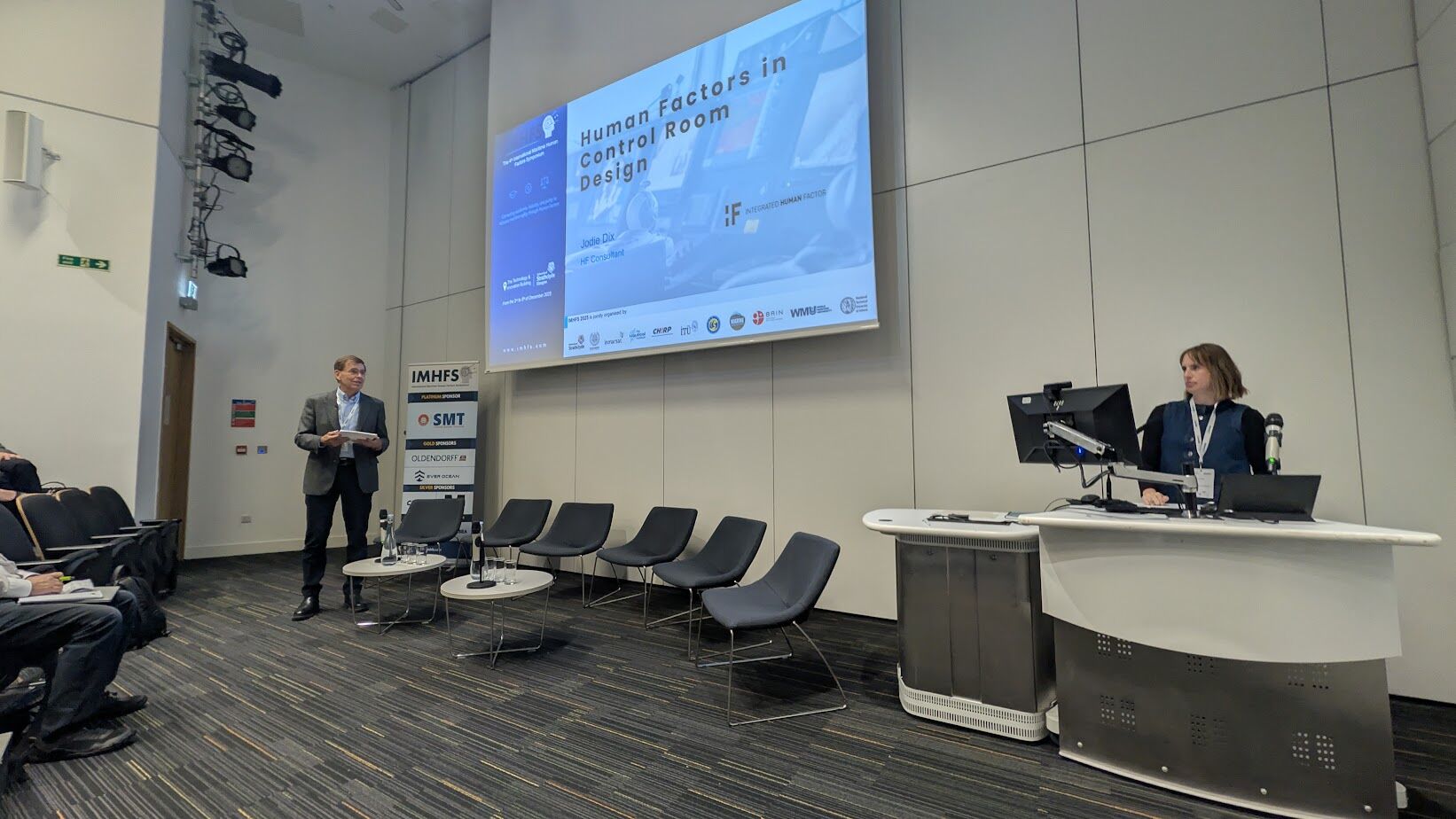
The process begins thorough ergonomic risk screenings and assessments to identify areas of concern. This can include detailed analysis of workstations whether in the office, home or hot-desking as well as evaluation of complex manual handling tasks in industrial, logistics and healthcare settings. IHF can also assess the ergonomics of control panels, control rooms and vehicle cab and cockpit environments and conduct field of view, reflection and mirror evaluations and safety and maintenance evaluations.

Analysis

Robust evidence-based methodologies are used to understand the root causes of physical and cognitive strain, supported by IHF’s comprehensive toolkit of validated observational and biomechanical analysis techniques and technologies. This ensures the right tools are matched to each risk, with advanced AI-driven digital human modelling and motion capture used where appropriate to provide objective, data-driven insights that go beyond subjective judgement.

Control

Based on experience, IHF develops targeted, practical and cost-effective controls tailored to each context ranging from workstation redesign and process changes to improved training programs, updated procedures and independent specification of suitable tools and equipment.

The Benefits of IHF Ergonomics Assessments to You, Your Workers, Your Organisation and the Public

Gain Financial and Productivity Benefits

A Human Factors and Ergonomics in Manufacturing & Service Industries research article suggests an average increase of 66% in productivity, 44% in quality, 82% in safety records and 71% in cost benefits following workplace safety initiatives.

Positive Cost-Benefit Analysis

According to a Journal of Safety Research study, commonly reported cost saving benefits of ergonomic programs included a reduction in lost workdays, restricted workdays and workers' compensation costs with additional benefits being related to productivity, quality, turnover and absenteeism, and payback periods for ergonomics interventions were typically less than one year.

Ergonomics Delivers Significant Benefits for Workers and Organisations

According to a Journal of Ergonomics commentary article: "Ergonomic interventions play a vital role in creating a safe, productive, and employee-centric work environment. By addressing the physical, cognitive, and organizational aspects of the workspace, organizations can enhance workplace efficiency and employee well-being.”

Leverage Award-Winning Human Factors Expertise

By engaging IHF to conduct your ergonomics assessments, you are partnering with award winning human factors experts who have a continuous improvement mindset and a passion to optimise workplace safety. This is demonstrated by the recent achievement of winning the Innovation Award at the Chartered Institute of Ergonomics and Human Factors (CIEHF) Awards 2024.

Could your ergonomics practices be improved?